Bacteria DNA Extraction Kit Spin Column Bacterium DNA Extraction Kit for Life Science Research
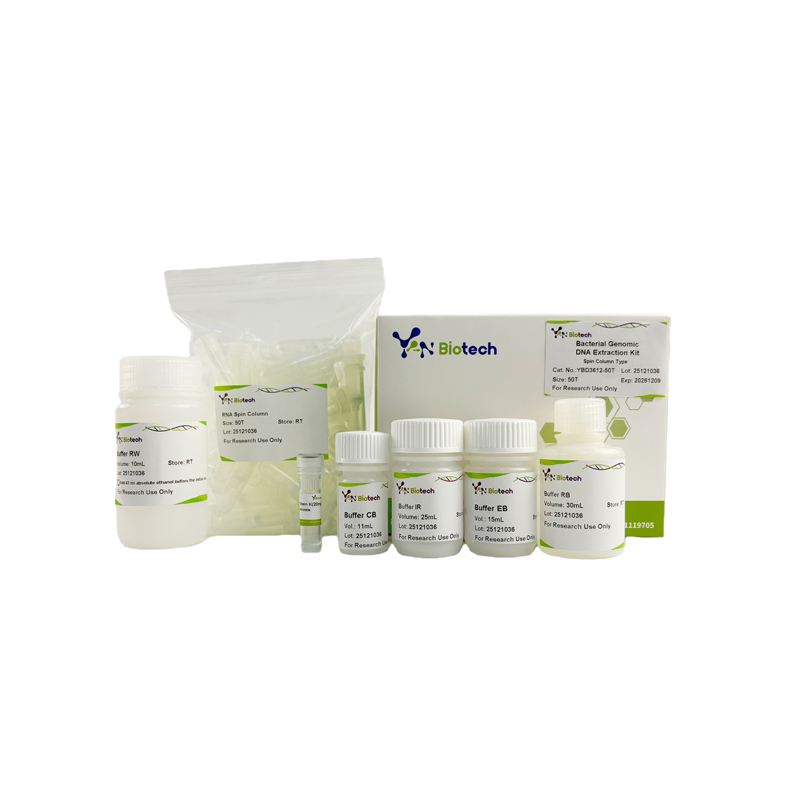
Suitable for Rapid Extraction of Genomic DNA from Various Bacteria.
Gato. No. :
YBD3612-50TMarca :
YanbiotechOrigen del producto :
ChinaVolumen :
50TEspeculación. :
Spin Column TypeI. Product Introduction
YBP3612-50T, Bacterial DNA Extraction Kits are essential tools in molecular biology, microbiology, and clinical diagnostics. They are designed for the purification of high-quality genomic DNA from bacterial samples for downstream analysi
II. Product Information:
Contents |
Storage |
YBP3612-50T | YBP3612-100T | YBP3612-200T |
| 50T | 100T | 200T | ||
| Buffer RB | RT | 30 mL | 60 mL | 120 mL |
| Buffer CB | RT | 11 mL | 20 mL | 40 mL |
| Buffer IR | RT | 25 mL | 50 mL | 100 mL |
| Buffer WB | RT | 15 mL | 25 mL | 2×25 mL |
| Add specified amount of ethanol according to the instructions before use | ||||
| Buffer EB | RT | 15 mL | 20 mL | 40 mL |
| Proteinase K, 20mg/mL | -20℃ | 20 mg | 2×20 mg | 4×20 mg |
| Spin Column Spin AC | RT | 50 pcs | 2×50 pcs | 4×50 pcs |
| Collection Tube (2mL) | RT | 50 pcs | 2×50 pcs | 4×50 pcs |
III. Storage Condition:
1. Buffer CB or Buffer IR may precipitate or form crystals at low temperatures. Incubate in a 37°C water bath for a few minutes to aid redissolution. Use after the solution returns to clarity and cools to room temperature.
2.To maintain activity and facilitate shipping, Proteinase K is provided as lyophilized powder. Upon receipt, briefly centrifuge the tube, then add 1 mL of sterile water to dissolve. To avoid reduced activity due to repeated freeze-thaw cycles, aliquot immediately after dissolution according to the single-use volume (20 µL) and store at -20°C.
3. Prevent volatilization, oxidation, and pH changes caused by prolonged exposure to air. Close the cap of each solution promptly after use.
IV. Product Feature:
1. The silica membrane in the spin column is made entirely of high-quality, specially formulated adsorption material, ensuring minimal variation in binding capacity between columns.
2. No need for toxic reagents like phenol or steps such as ethanol precipitation.
3. Fast and simple; processing of a single sample can typically be completed within 30 minutes.
4. Multiple column washes ensure high purity. Typical OD260/OD280 ratios range from 1.7 to 1.9. DNA fragments can reach 30-50 kb and are suitable for direct use in PCR, Southern blotting, and various enzymatic digestion reactions.
V. Application:
Suitable for Rapid Extraction of Genomic DNA from Various Bacterias.
VI. Procedure (Please read the precautions before starting the experiment):
1.Take 0.5-2 mL of bacterial culture (maximum not exceeding 2×10⁹ cells). Centrifuge at 10,000 rpm for 30 seconds. Aspirate and discard the supernatant as much as possible to collect the cell pellet.
The starting processing volume can be adjusted based on bacterial density, cell type, and expected yield. However, the maximum binding capacity of the spin column is 20 µg of genomic DNA. Excessive bacterial load beyond this capacity can severely reduce yield.
2. Resuspend the pellet in 200 µL of Buffer RB, centrifuge at 10,000 rpm for 30 seconds, and discard the supernatant. Thoroughly resuspend the cells by vortexing or pipetting in 180 µL of Buffer RB.
Note: For Gram-positive bacteria with more resistant cell walls, step 2 can be omitted, and lysozyme treatment can be used for cell wall disruption. Specific method: Add 180 µL of buffer (20 mM Tris, pH 8.0; 2 mM Na2-EDTA; 1.2% Triton X-100; add lysozyme to a final concentration of 20 mg/mL immediately before use. Lysozyme must be prepared by dissolving lysozyme powder in this buffer, otherwise it may be inactive). Incubate at 37°C for 30 minutes or longer.
3. Add 20 µL of Proteinase K (20 mg/mL) solution and mix thoroughly. Then add 200 µL of Buffer CB and vortex immediately to mix thoroughly. Incubate at 70°C for 10 minutes.
Optional Step: If significant RNA contamination is a concern, add 4 µL of RNase A (100 mg/mL) solution before adding 200 µL of Buffer CB, vortex to mix, and incubate at room temperature for 5-10 minutes.
4. After cooling, add 100 µL of isopropanol and vortex immediately to mix thoroughly. Flocculent precipitate may appear.
Immediate and thorough vortexing or pipetting mixing in the above steps is crucial. Inadequate mixing severely reduces yield. Vortex for up to 15 seconds if the sample is too viscous for easy mixing.
5. Transfer the mixture from the previous step (including any precipitate) into a Spin Column AC (placed in a collection tube). Centrifuge at 13,000 rpm for 30-60 seconds. Discard the flow-through in the collection tube.
6. Add 500 µL of Buffer IR to the spin column. Centrifuge at 12,000 rpm for 30 seconds. Discard the flow-through.
7. Add 600 µL of Buffer WB (Please verify that ethanol has been added!) to the spin column. Centrifuge at 12,000 rpm for 30 seconds. Discard the flow-through.
8. Repeat step 7: Add another 600 µL of Buffer WB to the spin column. Centrifuge at 12,000 rpm for 30 seconds. Discard the flow-through.
9. Place the Spin Column AC back into the empty collection tube. Centrifuge at 13,000 rpm for 2 minutes to remove residual wash buffer as much as possible, as residual ethanol may inhibit downstream reactions.
10. Transfer the Spin Column AC to a clean microcentrifuge tube. Apply 100 µL of pre-warmed (65-70°C water bath incubation is recommended for better results) Elution Buffer EB directly onto the center of the silica membrane. Let stand at room temperature for 3-5 minutes. Centrifuge at 12,000 rpm for 1 minute. Reload the eluate onto the same spin column, let stand at room temperature for 2 minutes, and centrifuge again at 12,000 rpm for 1 minute.
Larger elution volumes result in higher elution efficiency. If a higher DNA concentration is required, the elution volume can be reduced appropriately, but the minimum volume should not be less than 30 µL. Excessively small volumes reduce DNA elution efficiency and yield.
11. DNA can be stored at 2-8°C. For long-term storage, place at -20°C.

Stay Connected With Us



Derechos de autor
@ Wuhan Yanbiotech Co., Ltd. Reservados todos los derechos
.
 RED SOPORTADA
Xml / política de privacidad
RED SOPORTADA
Xml / política de privacidad
 Español
 English
 Русский
 Español